




Editor’s Note: The following is a guest column written by Patrick Smith | President & CEO | L.I. Smith & Associates of Paris.
I was twenty-eight years old when the attacks of September 11, 2001, occurred.
At the time, I had three boys under the age of six. I had graduated from Mississippi State University. I had already earned my professional surveyor’s license and was on pace to complete my engineering licensure. I was working inside my parents’ firm—L.I. Smith & Associates—in Paris, Tennessee, a company I had grown up in since I was ten years old walking survey lines with grown men. By sixteen, I was serving as a party chief. In college, I helped run one of my father’s offices in Starkville, Mississippi, which paid my way through school. By 2001, I had stepped into civic life through Rotary and was serving as a Henry County Commissioner. I was also teaching as an adjunct professor in the engineering department at the University of Tennessee at Martin.
I loved teaching. Eighteen-year-olds in 2001 were ten years younger than me. The pipeline felt full. We could not graduate enough engineers. Firms were offering sign-on bonuses. Infrastructure demand was steady.
Then 9-11 happened.
And I do not believe we have fully accounted for what it did to the engineering workforce. For several years now, I have been asking a simple question: Where are the forty-year-olds?
My workforce jumps from fifty to thirty. The middle thins. I see it in engineering firms, in accounting offices, in banking institutions, in IT departments, in soil science companies, and across state agencies. There is a visible mid-career gap.
I sit at the back end of Generation X, at what I describe as the throat of an hourglass. Above me are Baby Boomers and older engineers who remained productive because engineering rewards the mind. Below me are Millennials and Gen Z—numerous, intelligent, capable. But the natural integrators, the professionals now in their late thirties and forties who should be managing teams, translating complexity into execution, and carrying institutional knowledge—are thin.
National workforce data confirms measurable strain. The American Council of Engineering Companies reports that engineering retirements have recently exceeded the number of new graduates entering the field annually, creating a compounding deficit.^1 The American Society of Civil Engineers continues to warn that infrastructure investment and workforce capacity remain misaligned.^2 Construction industry surveys show that a significant majority of firms struggle to hire qualified workers, including credentialed professionals.^3
Those data points are real.
But I believe there is a deeper structural shift that has not been fully discussed.
Beginning in 2001, the United States expanded its military commitments dramatically. According to Department of Defense manpower reports, Army active-duty end strength increased from approximately 482,000 in 2001 to more than 560,000 during the surge years of the Iraq and Afghanistan conflicts.^4 The majority of enlistees during that period were between eighteen and twenty-four years old.^5 That is precisely the same demographic that traditionally fills undergraduate engineering programs.
More than 2.7 million Americans deployed in support of operations in Iraq and Afghanistan over the next two decades. ^6 Many served ten, fifteen, or twenty years.
That is not a temporary detour. That is a full professional maturation cycle occurring outside the civilian engineering pipeline.
I witnessed this redirection personally. While working in Memphis in the mid-2000s, I was active in the Society of American Military Engineers and spent time with the U.S. Army Corps of Engineers. We designed forward operating bases in Afghanistan to Corps standards. We secured special insurance policies. We coordinated late-night calls across time zones. One of our engineers lived in shipping containers in the Afghan countryside supporting construction efforts. It was wild, high-risk engineering.
The scale of spending overseas was enormous. At the same time, domestic infrastructure aged. ASCE’s recurring infrastructure report cards—grading much of our national infrastructure in the “C” range—reflect the cumulative impact of underinvestment. ^7
This is not a political argument. It is an observation about talent flow.
Thousands of technically inclined young adults matured inside military and intelligence structures rather than inside engineering firms. They learned logistics, risk management, distributed systems coordination, and execution under constraint. Many now re-enter civilian life in their late thirties and forties, bringing extraordinary systems-thinking capacity. Yet they often do not return through traditional licensure pathways.
Meanwhile, the civilian engineering ladder has inverted. When I was climbing in the early 2000s, upper positions were crowded. Advancement was compressed. Today, in many organizations, entry-level professionals can see straight to the top because the middle layer is thin.
In 2016, when Nashville International Airport announced its $9 billion expansion program, national contractors openly acknowledged that the skilled workforce numbers projected locally did not exist. Those professionals would have to be pulled from elsewhere.
Without a robust mid-career layer, firms struggle to scale. Institutional knowledge transfer weakens. Young engineers lack seasoned translators between theory and execution. Growth becomes incremental rather than exponential.
Workforce development has been a lifelong pursuit for me—from managing crews as a teenager to recruiting in universities to sponsoring STEM programs and serving in professional leadership roles. Human capital is the most valuable resource we possess. When refined properly, it is gold.
What I am observing is not merely a hiring difficulty. It is the long-term demographic effect of a national redirection of technically capable youth beginning in 2001. The military hardened their systems thinking and developed leaders. Now, as infrastructure needs accelerate and generational turnover intensifies, the built environment must recognize that misaligned talent and create pathways for reintegration.
Engineers’ Week, which is celebrated every year, should not only celebrate the profession. It should compel us to examine structural gaps that determine our capacity to build.
I stand at the narrowest part of the hourglass. I can see both directions clearly. The forty-year-old integrator is the most valuable person in the room.
We simply must recognize him when he walks in.
Footnotes
- American Council of Engineering Companies, “5 Numbers That Explain America’s Engineering Shortage,” Engineering Inc., ACEC Research Institute,
https://engineeringinc.acec.org/blog/5-numbers-that-explain-americas-engineering shortage/.
- American Society of Civil Engineers, 2021 Report Card for America’s Infrastructure, https://infrastructurereportcard.org/.
- Associated General Contractors of America, Workforce Survey Results, https://www.agc.org/learn/construction-data/workforce.
- U.S. Department of Defense, Defense Manpower Data Center, Active Duty Military Personnel Strength Reports (2000–2015), https://dwp.dmdc.osd.mil/dwp/app/dod-data reports/workforce-reports.
- Office of the Under Secretary of Defense (Personnel & Readiness), Population Representation in the Military Services, annual demographic reports,
https://www.cna.org/pop-rep.
- U.S. Department of Veterans Affairs, National Center for Veterans Analysis and Statistics, veteran deployment data, https://www.va.gov/vetdata/.
- American Society of Civil Engineers, 2021 Infrastructure Report Card.
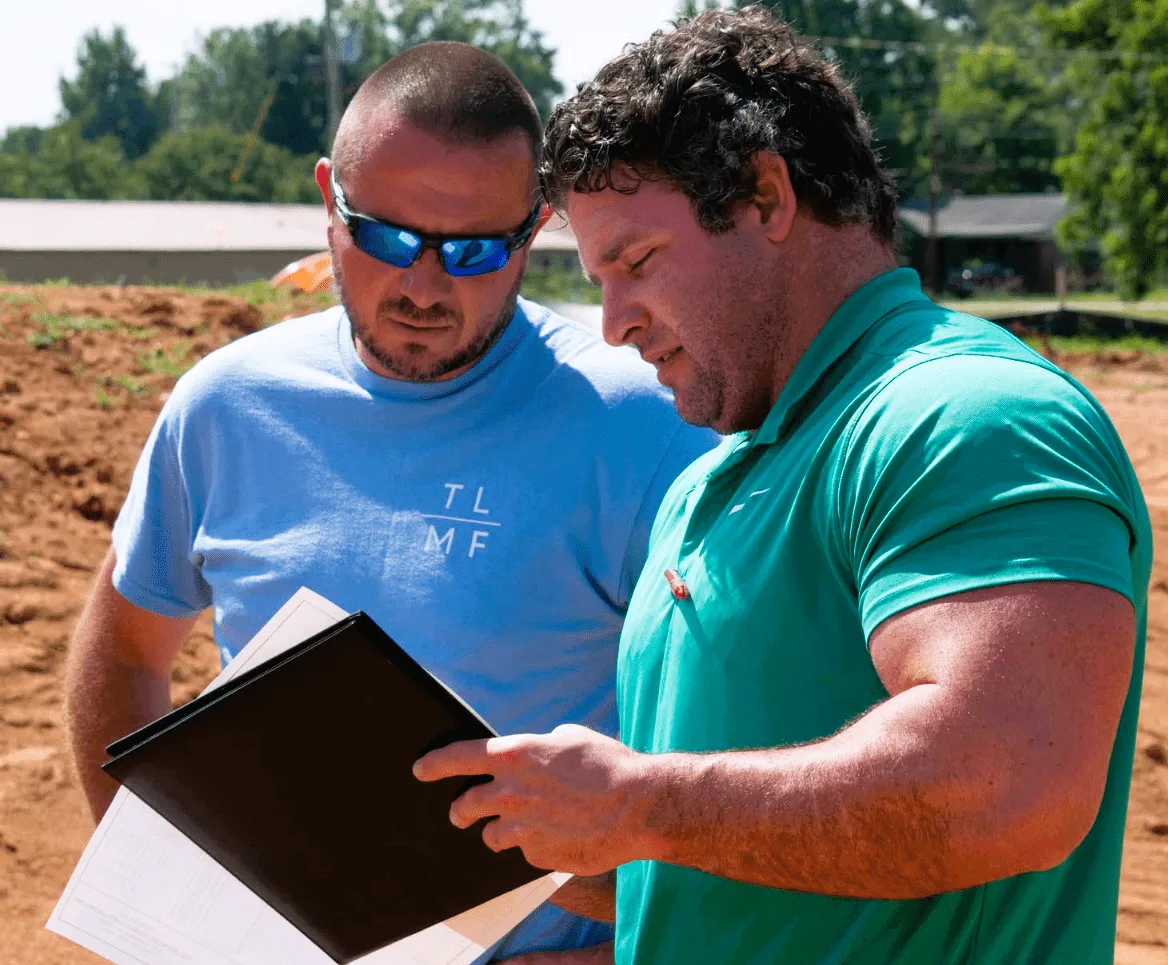
Photo: Left – David Miles with the Levi Miles Foundation; right – Will Clark, Engineer for LIS. They are seen here working on the new playground in Paris. Levi Miles Foundation playground.